
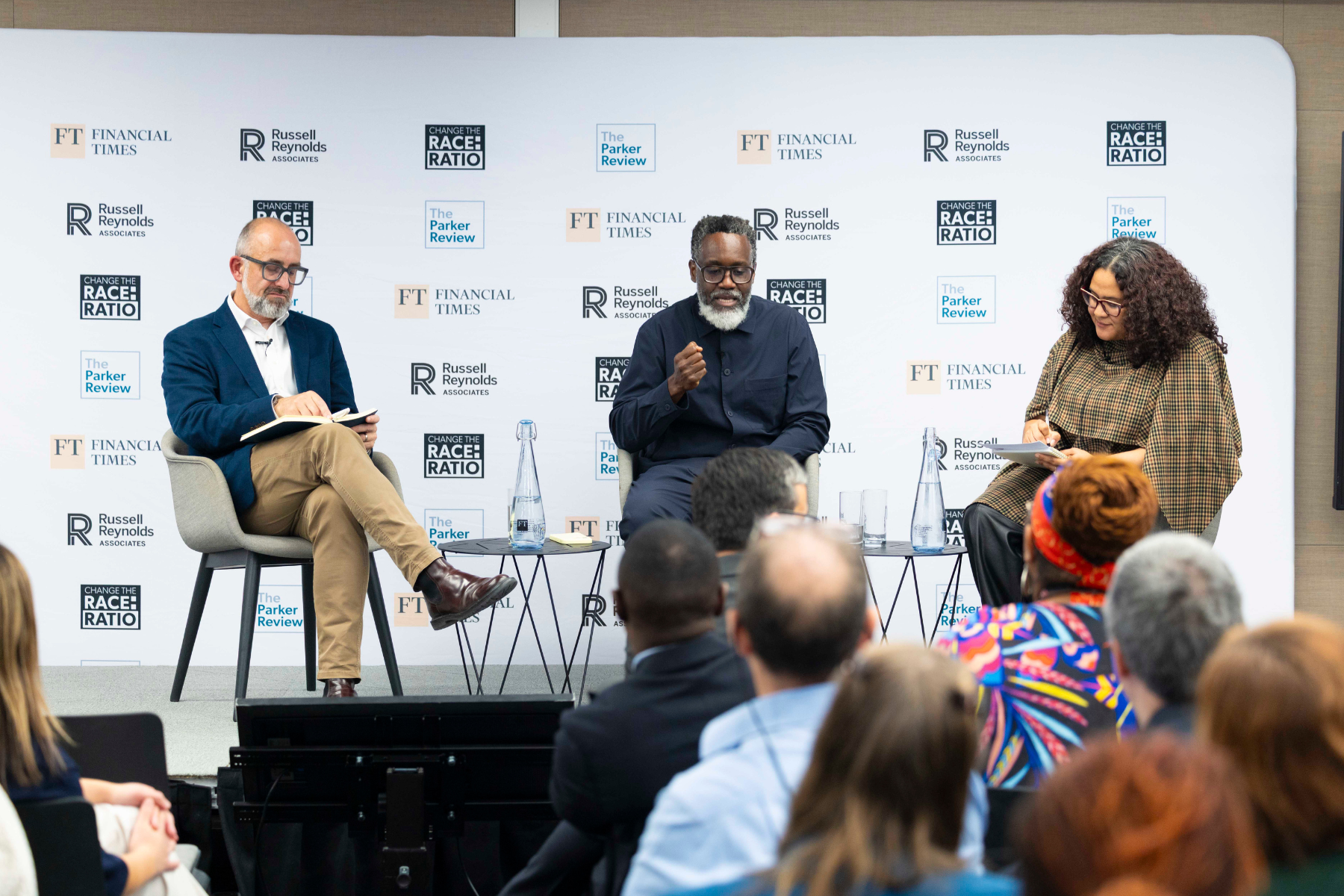
Change the Race Ratio brought together members at the Financial Times HQ in London for a business leaders’ reception to mark the mid-year point of the Parker Review. The purpose of the event was to have an open and candid discussion on leadership, growth and the role of the CEO in building high-performing organisations. The session featured keynote speakers including Satvir Kaur MP, Minister for Equalities, Soumen Das, Chair of the Parker Review and Laura Sanderson, Managing Director, Board and CEO Advisory Practice, Russell Reynolds Associates. The main event featured a panel with Jon Slade, CEO of the Financial Times and Ije Nwokorie, CEO of Dr. Martens.
Collective intelligence in the age of AI
Laura Sanderson opened the discussion by exploring what it means for an organisation to be intelligent at a time when organisations are adapting to rapid AI development and adoption. She argued that leaders should think beyond machine intelligence and focus on collective intelligence that brings together different experiences, knowledge and perspectives. This is backed up by Russell Reynolds’ latest survey data that showed 57% of business leaders worry that an overreliance on AI may erode the ability to think critically. This, she argues, is what makes diversity important as organisations relying on the same technologies, the same information and similar ways of thinking can only result in group think. Having a diverse leadership team can provide the right breadth of challenge and perspective to make better leadership decisions - but this only works when there is enough trust to create constructive friction that improves decision-making.
Talent is everywhere, opportunities are not, says Minister
Equalities Minister Satvir Kaur MP followed up on this by emphasising the importance of making the full use of talent available. She reiterated a critical campaign message of Change the Race Ratio, people are not less talented due to their background or ethnicity, but rather are given fewer opportunities or face barriers that limit their ability to demonstrate that talent. The Minister also used this opportunity to reinforce the government’s commitment to introducing mandatory ethnicity pay gap reporting, but doesn’t view transparency as an end in and of itself. Rather, organisations that are equipped with workforce data should use it to identify where inequalities exist and take action to address them.
Progress has been made but there is more work to do in the middle pipeline
The companies that are engaging their workforce data have made significant progress. Soumen Das, as chair of the Parker Review, highlighted that 98% of the FTSE 100 and 82% of the FTSE 250 have at least one board director from an ethnic minority background – more than double from when the Parker Review was set up in 2015. However, Soumen emphasised there is still more work to do. Black representation in senior management stands at 1.3% against a 4% share of the population, while of the 14 ethnic minority CEOs in the FTSE 100, none are female. The change, he argues, should start at the top but there should also be a focus on the middle pipeline.
Soumen shared anecdotes from his conversations with organisations that representation in early careers and at board level are relatively proportionate, but the middle block of professionals is the cohort that is overlooked. A typical mid-level manager has competing priorities such as deadlines and targets that can take their attention away from building inclusive culture. Soumen encouraged organisations to speak, convene and share ideas on how to tackle this leaking pipeline issue and make sustainable, long-term progress.
CEOs Panel: Making room for constructive challenge
In a conversation that moved effortlessly between culture, commerce and identity, CEOs Jon Slade and Ije Nwokorie offered a candid, unvarnished reflection on what leadership demands in a moment when Britain, and by extension British business, are at a crossroads. Jon, from a journalistic perspective, shared how societal division bleeds into workplaces and can shape culture, while Ije reflected on how Britain lost its ‘mojo’ as a beacon for cultural confidence.
This was central to the panel discussion with both leaders engaging their employees to explore how culture and leadership behaviour shape people's ability to contribute and progress. Jon held more than 20 listening sessions with colleagues across different functions, seniority levels and backgrounds and the conversations revealed that some employees felt the organisation was succeeding despite the way it was structured, rather than because of it. Jon expressed he needed to create the space for constructive challenge. He referenced the FT’s Next Generation Board – an initiative whereby 10 emerging leaders who represent different business areas across the organisation are paired with a member of the FT’s Executive Board to provide reverse mentoring. This programme has allowed mid-career talent to gain direct access to the senior leadership team, while also connecting board members to the everyday concerns and priorities of their employees. A key facet of this has been to create a space for open dialogue, constructive feedback and collaboration.
Creating an inclusive workplace and moving beyond cultural fit
Ije, when asked how important inclusivity is to the organisation, notably said it was “essential” for the survival of Dr. Martens. The business does this by encouraging discussion and debate, as he recalled collating email responses by employees after he asked what excites them about the company and what it can do better. Modelling this behaviour of open and honest dialogue, and in a direct manner where employees have access to the CEO, is a prime example of building the type of culture Ije set out to build. In his words, he said this exercise was a “signal to the organisation that everybody’s voice matters”. Ije also recognised people contribute in different ways: some prefer to have in-person debates while others prefer to write out their thoughts, and he recognised this by employing different avenues for challenge.
Ije also contested the idea of ‘cultural fit’. Instead, he argued, businesses need what he described as ‘requisite variety’: different experiences, strengths and perspectives that enable organisations to navigate complexity. High-performing teams do not need everyone to think alike they need people who can test assumptions, bring different insights and work together towards a shared goal. This requires a distinction between shared values and uniformity of thought. Organisations should be clear about the behaviours they expect from their people, without expecting everyone to have the same background, outlook or approach. The objective, Ije says, is not agreement for its own sake, but constructive disagreement that leads to better business decisions.
Humility, intersectionality and opening doors
Both CEOs acknowledged that they do not know everything, and stressed leaders require a humility to understand the different needs of individuals. Ije was honest in his reflection about his lived experience as a Nigerian man differing considerably to that of a Ghanaian man, emphasising that it’s important to understand the lived experiences of individuals in your workplace, the barriers they face, and ultimately identify how to harness their talents.
Jon also shared that aspirant journalists may have a preconceived notion that working at the FT or the media industry may not be for them. To tackle this, he explained the outreach programs that they are involved in, such as the FT News School. This initiative enrols children from lower socio-economic backgrounds, demystifying what it is like to work at an international media organisation and is followed up by a 6-month mentoring program.
This is all done with the view to create truly inclusive workplace cultures and to increase the diversity of their future talent pipelines. And when asked what their respective organisation can do to harness the talent that already exists within their workforce, Ije used this opportunity to take away an action and ask questions of his own organisation: what does the talent pipeline at senior management look like, what opportunities should the board give to underrepresented talent, and who on the board can mentor them?
The insights shared at the reception highlight both the progress achieved and the complexity of the hurdles that remain. Organisations are operating in a rapidly changing social and technological environment, and both CEOs acknowledged the headwinds facing this agenda. However, they were unwavering in highlighting the importance of building more diverse talent pipelines, modelling inclusive leadership behaviours, and leading with cultural intelligence. As representation continues to progress at the top, our collective focus must now turn to sustaining that progress throughout the middle pipeline and ensuring that diversity translates into meaningful voice, constructive challenge and better decision‑making.