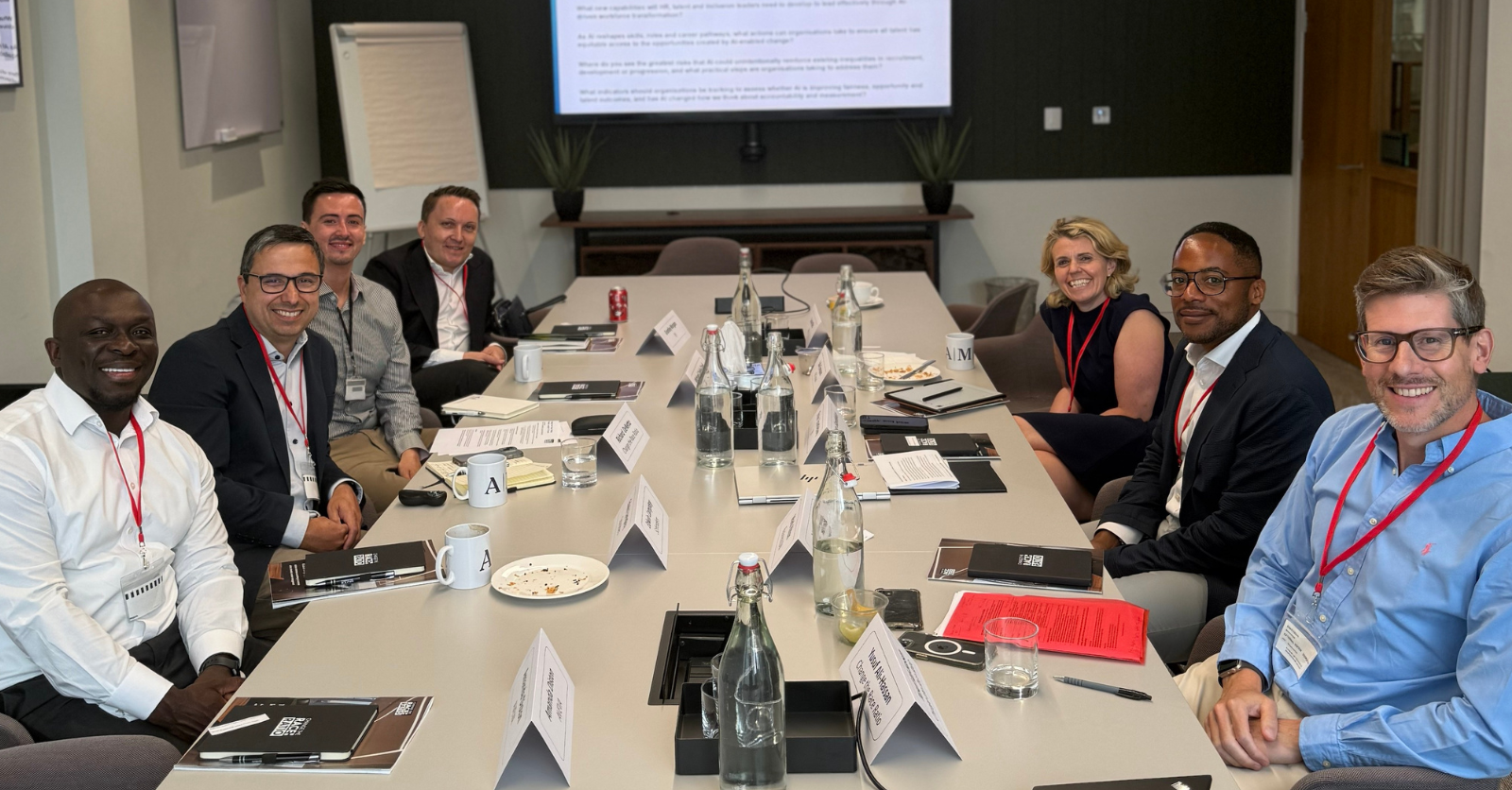
Change the Race Ratio brought together members at AMS's offices in London for a candid, peer-level roundtable on how AI is reshaping the way organisations hire, develop and promote talent. The conversation also centred around how to ensure progress on AI adoption remains inclusive.
Building on the conversation started at the Parker Review reception in March, the session featured guest speaker Shaun Scantlebury, Partner at EY, who shared findings from his recent report, Performance Reimagined: How Gen AI Transforms Team Performance, before opening the floor to a discussion with members.
What the research tells us
Shaun explained that the research, which drew on interviews and surveys across UK organisations, identifies four broad segments of AI adoption, ranging from "sceptics," where investment and access is limited to a small part of the workforce, to "explorers", "scalers," and "transformers", the latter of whom are organisations using AI to fundamentally redesign how work gets done rather than simply layering it onto existing processes. Transformers have adaptive cultures open to experimentation, visible leadership AI use, cross-functional "open teaming," and sustained investment in learning, with breakthrough benefits typically only appearing once employees have invested significant time.
“The real difference with the transformers is they’re not looking at this as a technology thing. This is very much a human and workforce issue.” Shaun, EY
A potential two-speed workforce
One of the report's findings was the emergence of a "broad but shallow" pattern of adoption where the majority of AI use remains concentrated in low-complexity tasks such as drafting emails or summarising documents, while only a small minority of employees are using AI for higher-value work like deep research, coaching or evaluation. Interestingly, the data showed the more senior an employee, the more likely they are using AI. 74% of C-Suite executives use AI tools daily, but this drops to 28% for entry-level or graduate employees. Members expressed the risk of a two-speed workforce this could create where those already best placed to extract value from AI pull further ahead.
This sparked a discussion about cost as a barrier to equitable access, with members raising concerns that the shift from subscription-based tools toward token-based pricing models could further disadvantage organisations, sectors and individuals with less resources.
AI in leadership and governance
A recurring theme was the pace of change outstripping organisations' ability to govern it. Members described the tension between wanting to experiment and innovate, and the caution imposed by legal, data and cybersecurity governance frameworks. As such, by the time a policy has cleared internal governance, the technology has often already moved on. Several noted that even highly regulated sectors are moving faster than expected, driven by a competitive pressure to be seen as innovative.
As AI becomes more embedded in everyday processes, members also raised the question of who becomes accountable for the performance of agents? How are they managed, and how can they be retired? There was a shared understanding the HR should get ahead of these questions now and build agentic AI into governance frameworks.
The risk to inclusion
Several members made the point that widescale AI adoption could potentially undermine the progress organisations have made on equity, diversity and inclusion. Analysis from the Living Wage Foundation shows ethnic minority workers are more likely to be employed in the UK’s most insecure jobs, and thus it is likely that an AI-driven workforce transformation could disproportionately affect these populations. Functions such as customer services and admin roles that have historically provided meaningful early career work experience are most at risk of being displaced by AI.
Without a developed and intentional workforce planning strategy, ethnic minorities could face an asymmetric impact that could lead to reduced representation across all job grades. Members agreed to start embedding an inclusion lens when discussing AI and its impact on their workforces, including retraining and reskilling at-risk employees into more in-demand jobs.
Concluding thoughts
This was a session defined by cautious optimism. There were members pointing to the democratisation of AI with its ability to accelerate learning, broaden access to knowledge, and broaden horizons that may have historically been slow to shift. But any developments do not happen in a vacuum, with one member pointing out that a workplace may be the only time people encounter AI tools. Therefore, people leaders are working to ask the questions of inclusion early and aim to bring some rigour to AI governance that supports equitable and inclusive access.