As businesses navigate an increasingly polarised social and political environment, maintaining a commitment to workplace inclusion has become both more challenging and more important. With public debates around race, immigration and diversity becoming increasingly contentious, organisations face growing pressure to demonstrate how their inclusion commitments translate into meaningful action.
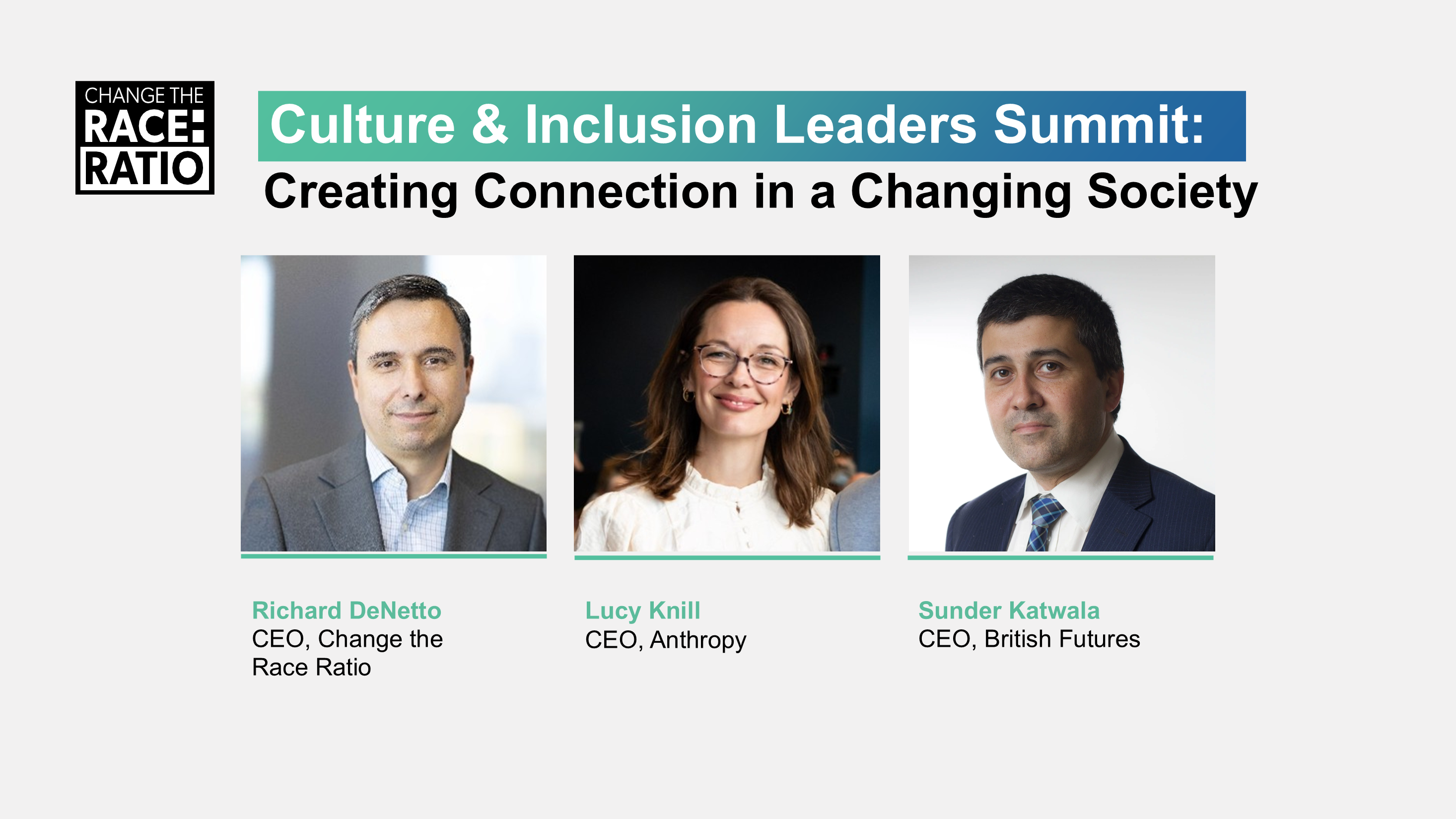
The winter edition of our biannual Culture and Leaders’ Summit, kindly hosted by Schroders, brought EDI professionals together to discuss how to build warmth and connection in a rapidly changing society. The session featured insights from Sunder Katwala, Director of British Future, and Lucy Knill, CEO of Anthropy, but not before an insightful opening presentation from Stephanie Ashmore, Global Head of Talent, Inclusion and Employee Experience at Schroders.
Spotlight on compassion
A central theme was the importance of creating workplace environments where employees can better understand one another, particularly when wider societal debates risk reinforcing divisions. Stephanie shared Schroders’ Spotlight on Compassion initiative, designed to encourage colleagues to engage with different lived experiences through empathy and mutual understanding.
Through a series of events exploring personal experiences of exclusion, discrimination and prejudice, the organisation has sought to move beyond conversations focused solely on individual identities towards a broader understanding of compassion. An important learning from the initiative was how organisations frame inclusion activities can significantly influence engagement. Events perceived as relevant only to particular communities risk limiting participation, even when their underlying messages have wider relevance.
Stephanie was very candid in sharing that the objective of the events were not to make employees an expert in different aspects of diversity and inclusion, but to equip colleagues with the empathy and confidence to support one another, especially at times when wider societal events affect their experiences at work. Schroders have continued to build on this approach through activities such as Walk In My Shoes, bringing together ERG chairs to share their experiences and perspectives. The experience offers a valuable lesson for organisations seeking to sustain engagement on inclusion as creating more compassionate workplaces requires both raising awareness and helping employees recognise their shared responsibilities towards one another.
Reframing inclusion around fairness and shared opportunity
The fireside chat with Sunder and Lucy explored how fairness is a key pillar of inclusion. Research presented by British Future, where more than 5,000 people were surveyed, highlighted the growing perception that Britain is becoming more divided, with many people concerned that progress on race equality is at risk. Almost half (44%) of ethnic minority respondents and white respondents (48) believed racial equality is increasingly at risk, with 46% of ethnic minorities experiencing racial or nationality-based prejudice in the preceding year.
One of the research's most significant findings was that attitudes towards racial equality were often more strongly influenced by age, education, political outlook and contact with people from different backgrounds than by ethnicity alone. Sunder cautioned against assuming that ethnic minority and white majority communities hold uniformly opposing perspectives. Instead, both populations contain a wide range of attitudes towards fairness, discrimination and the measures needed to address inequality. The research also revealed a distinction between perceptions of wider society and people's everyday experiences, which are often considerably more positive.
While public debates can suggest deeply entrenched divisions, there remains significant common ground around the importance of fairness, equal opportunity and tackling discrimination. This presents an opportunity for businesses to communicate inclusion in ways that resonate with employees across different backgrounds. Discussions emphasised that inclusion should not be presented as a zero-sum exercise, where progress for one group comes at the expense of another. Instead, organisations should articulate how fair recruitment, equitable progression and inclusive workplace cultures benefit the wider workforce.
Importantly, this does not diminish the need for targeted interventions where evidence demonstrates persistent inequalities. Rather, it reinforces the importance of explaining why such interventions are necessary within a broader commitment to fairness for everyone.
Another key theme was the importance of ensuring that progress on representation translates into meaningful opportunities for progression and leadership. Drawing on Anthropy's Board Representation research into gender equality, members heard how improvements in representation at Board level do not necessarily translate into equivalent representation in executive leadership positions. Indeed, women’s representation on FTSE 350 boards stands at 43%, but this drops significantly to 8% representation at CEO level.
The discussion highlighted the need to examine the organisational structures and processes that determine who progresses into positions of influence. These include access to sponsorship, commercially significant assignments, development opportunities and succession planning. For businesses seeking to improve ethnic minority representation in senior leadership, increasing diversity within talent pipelines is important, but organisations must also understand where barriers to progression persist and take action to address them.
Members also explored the growing influence of social media in shaping attitudes towards race, immigration and inclusion. Speakers highlighted how online algorithms and increasingly fragmented information environments can reinforce existing perspectives, amplify extreme viewpoints and contribute to perceptions of greater societal division. These challenges do not remain outside the workplace. Employees bring their experiences, concerns and perspectives into their professional environments, creating new challenges for leaders seeking to maintain inclusive cultures.
However, workplaces also offer an important opportunity to bridge divides. By bringing together people from different backgrounds, generations and perspectives, businesses can create spaces for meaningful interaction that may be increasingly limited elsewhere in society. The discussion reinforced the importance of encouraging constructive dialogue, challenging assumptions and creating opportunities for colleagues to engage beyond their immediate networks.
There was broad agreement that businesses do not need to have all the answers to make progress. Instead, they should focus on understanding what works, sharing those insights and embedding effective approaches within their organisations.