The traditional formula of CVs, red-brick degree requirements, linear career paths and job titles is beginning to give way to a dynamic skills-based approach. At our recent Knowledge Share Forum, members came together to discuss why and how businesses are adopting a skills-based approach to talent management.
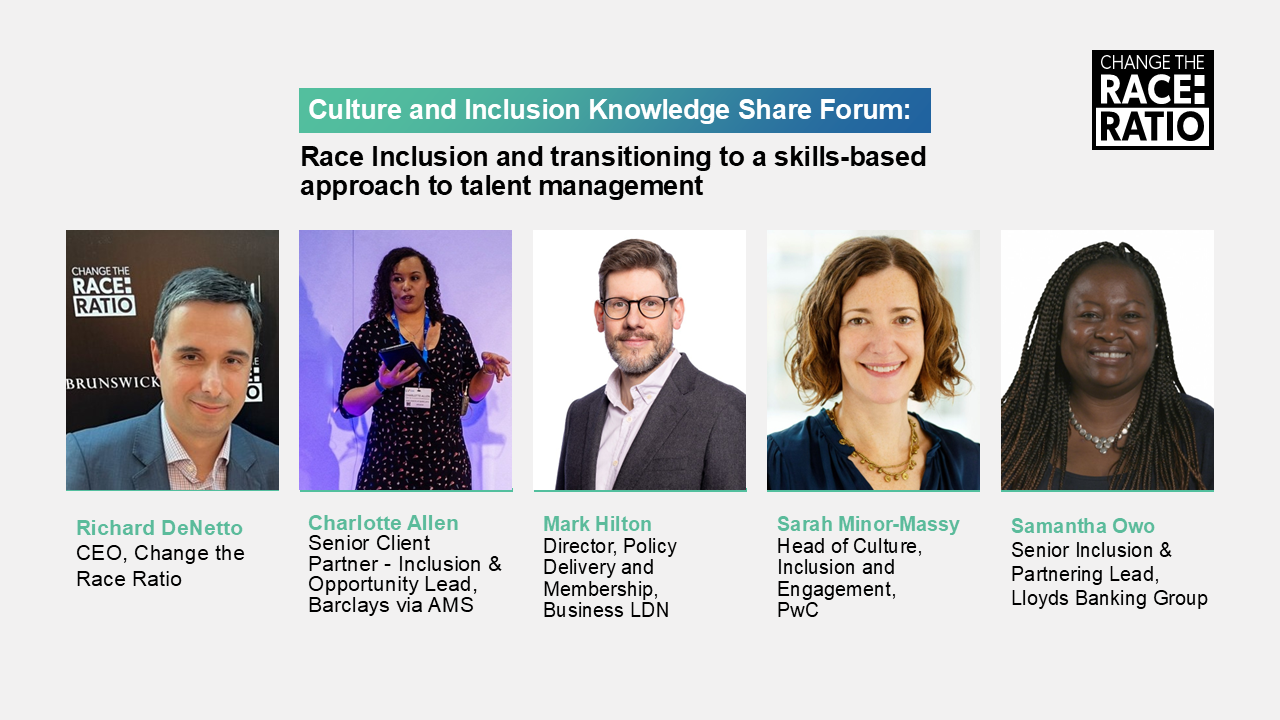
Chaired by Richard DeNetto, CEO of Change the Race Ratio, the session brought together expertise from organisations actively navigating this transition:
- Charlotte Allen, Senior Client Partner, Inclusion and Opportunity Lead at Barclays via AMS
- Mark Hilton, Director of Policy, Delivery and Membership at Business LDN
- Sarah Minor-Massy, Head of Culture, Inclusion and Engagement at PwC
- Samantha Owo, Senior Inclusion and Partnering Lead at Lloyds Banking Group
What is a skills-based approach to talent management?
Charlotte defines a skills-based approach as focusing on what people can do rather than where they come from or where they were educated. In practice, this means building what Sarah describes as a “skills taxonomy”, a term that defines the skills required across roles and functions within an organisation, from technical and digital capabilities to leadership, communication and problem-solving.
This approach also changes how potential is recognised as it creates space for transferable skills to be seen and valued on equal terms. For people from underrepresented backgrounds, who are statistically less likely to have accumulated the traditional credentials that gatekeep senior roles, that shift in recognition can support career development and progression.
Truly inclusive talent management means designing the whole system
Samantha mentioned that inclusion would fail if organisations focus on just one stage and leave the rest of the system unchanged. From attraction and selection, to onboarding, development and progression, to exit, the entire colleague journey needs to be examined with an equitable lens. Sarah echoed this and reiterated that central to this is disaggregated data that shows where different groups are dropping off and where unequal outcomes are emerging.
Mark illuminated this point by highlighting that employment rates for Black Londoners stand at 68% versus 80% for white Londoners, which, he says, is a drag on London's economic performance.
"Inclusive talent management should never be a bolt-on diversity programme. It should always be integrated and be a systematic way of designing how organisations attract, develop, retain and progress people, so that opportunity is widened by default, not by exception." Mark Hilton, BusinessLDN
Why organisations are moving towards a skills-based approach
Charlotte outlined the scale of the opportunity that moving to a skills-based approach offers. For example, removing degree requirements alone can drive a significant increase in the diversity of applicants reaching interview stage.
Sarah pointed to data from the World Economic Forum showing that 58% of employees believe the skills their job requires will change significantly in the next five years. In that context, continuing to recruit and promote based on what people have done, rather than what they can do, risks building a workforce not fit for the future of work.
PwC is a year into that journey and has tasked colleagues to document their skills which is connected to a learning system that recommends personalised development. The biggest challenge, Sarah noted, is not the technology, but bringing people along at a time when fear around AI and job loss is real.
Sponsorship and access to opportunity remain critical
Access to opportunity such as stretch assignments, career-enhancing roles, development programmes, and visibility with senior leaders is what translates skills into progression. And access to those opportunities remain unequal. Talent without advocacy, Sarah said, is less likely to be progress.
The panel agreed that conflating sponsorship with mentoring is one of the most common failure points. Mentorship is about guidance while sponsorship is about using your position, voice and influence to actively open doors for talent who do not have access to them.
A skills-based approach alone will not solve inequitable access to opportunity
The panel said that a skills-based approach is not a silver bullet. Without careful design and intentionality, it can reinforce the very inequalities it promises to address.
Charlotte pointed to a UCL study finding that Black applicants are 45% less likely to receive an offer for an entry-level professional role than white applicants. Online assessments, which were introduced specifically to reduce bias, have been found to disadvantage candidates who received free school meals at age 14 by as much as 40%. There are also risks around AI, with Charlotte highlighting the Eightfold class action in the US as a live example of how AI-driven hiring models can embed existing biases.
Samantha raised a different point about skills frameworks not being neutral. Career continuity and sector-specific experience can translate as capability, while transferable skills that are more likely to be held by people with non-linear career paths, career breaks or moves across sectors, are seen as weaknesses rather than strengths.
What organisations should do now
Mark offered a test to ask whether your talent management system would work for someone without networks, confidence, financial cushioning or a conventional CV. If the answer is no, then your system is still designed around advantage. Sarah reiterated that data is the foundation of everything and should be disaggregated from day one, tracked across the full talent lifecycle, and used not just to report but to redesign. And Samantha added that leaders must be accountable and deliberate about project allocation, sponsorship and development programmes.