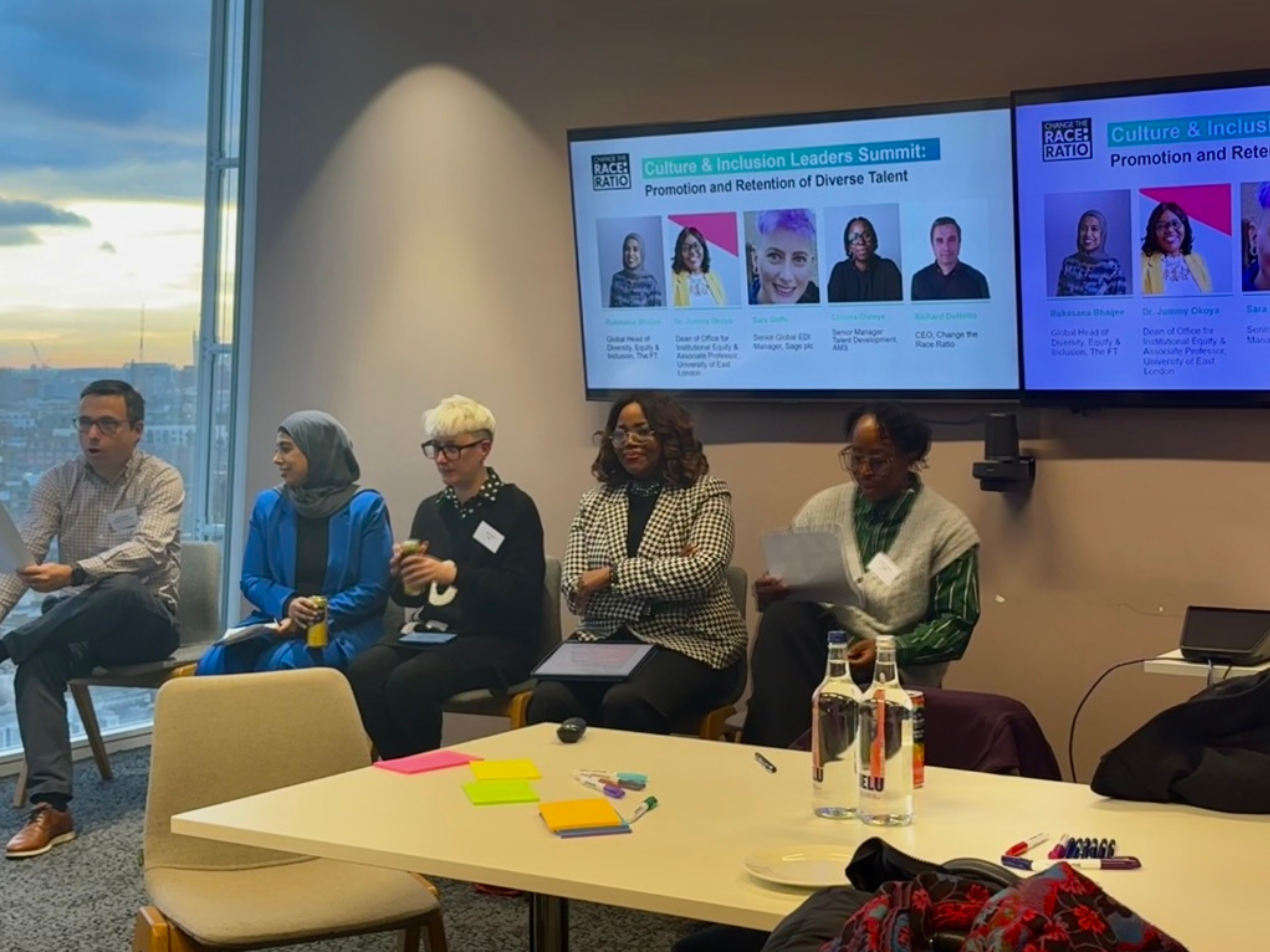
Our November 2025 Culture and Inclusion Leaders’ Summit brought members together for another energising panel discussion, on the topic: Retention and Promotion of Diverse Talent.
Our speakers included:
- Chioma Olaleye, Senior Manager, Talent Development, AMS
- Dr. Jummy Okoya, Dean of Office for Institutional Equity & Associate Professor, University of East London
- Rukasana Bhaijee, Global Head of Diversity, Equity & Inclusion, The FT
- Sara Goffe, Senior Global EDI Manager, Sage plc
- Richard DeNetto, CEO, Change the Race Ratio (facilitator)
Developing aspirant ethnic minority talent
Chioma began by highlighting AMS’s flagship development program, called ‘EmBue’, Empowering Black and Underrepresented Ethnicities. She outlined how the program pairs a colleague from an underrepresented background with both a mentor and a sponsor. Mentors support participants in discussing challenges, while sponsors use their position and platform to advocate for them, opening doors to new opportunities for stretch projects or promotions.
Over the course of the six-month program, participants engage with senior leaders, receive training, such as on presentation skills and ultimately for them to deliver a ‘Ted-Style Talk’ to a panel of senior leaders. The initiative provides meaningful exposure and development opportunities. Participants described the experience as inspiring and even emotional, sharing personal stories about feeling unseen and gaining the chance to communicate directly with senior leaders about how meaningful change can be achieved.
Since its launch in 2024, results have been strong. Ethnic minority representation in AMS’s global leadership has risen from 4% in 2020 to 18.5% in 2025, with ambitions to grow further by 2026. Fourteen leaders have completed the programme to date, with zero voluntary attrition and two promotions to Senior Management.
100 Black Professors Now
Dr. Jummy shared a powerful case study from higher education: the 100 Black Professors Now programme, created by the Women’s Higher Education Network (WHEN). Launched in 2021, it set out to address the severe under-representation of Black female professors in the UK - just 0.2% of all professors, or 35 individuals, at the time.
The programme focuses on enabling equitable progression by engaging three stakeholder groups: institutional leaders, line managers, and the academic cohort. Each participant receives a career coach who works with them and their line manager to ensure clarity, alignment, and fairness around promotion expectations.
Since launch, the programme has contributed to meaningful sector-wide impact, with the number of Black female professors increasing to 95. It has helped remove systemic barriers through structured development, improved transparency, and more objective promotion processes.
Developing leadership confidence when it comes to race in the workplace
Rukasana then highlighted the FT’s work to build leadership capability and confidence around race and inclusion. Drawing on her experience across the creative industries, she noted a recurring misconception among leaders that people of colour were “not attracted” to sectors like publishing or media—when in reality, many faced environments that did not feel inclusive.
Her focus has been on developing systems and leadership capability rather than “fixing the talent”. The FT introduced quarterly leadership touchpoints that enable leaders to reflect on their own experiences, engage with lived experiences across the organisation, and articulate their personal “why” for DEI. These sessions strengthen leaders understanding of psychological safety, race fluency, and the workforce data that really matters to ultimately build confidence and improve objectivity during key moments, such as promotion rounds.
Learnings from sponsorship programmes
Sara spoke about Sage’s sponsorship program to support female black colleagues in South Africa that was launched recently, after receiving feedback from their race and ethnicity networks that just like their mentoring program, they needed this to help with opportunities.
The program was centred around three principles:
- Building communities and connections
- Building longevity into the program, developing strong foundations and
- Building a sponsorship mindset for leaders
The aim was to help colleagues build their network and help develop their skillset, through a six-month journey which focused on leaders advocating for their career advancement and personal growth.
It was designed to support their career journey, and the relationships networks they built would provide them with long-term support and stretch opportunities as they continue to grow.
Mid-programme survey results showed participants felt more seen within the organisation, more confident, and more likely to progress due to having advocates at senior levels. Leaders also gained a deeper understanding of what structured, equitable pathways to promotion should look like.
Ensuring critical opportunities are genuinely open to all talent
The panel also explored how organisations can democratise in role, stretch projects often termed ‘high visibility’ assignments to ensure they are truly open to all and not just the chosen few.
Chioma discussed how AMS have implemented a platform that offers all colleagues equal and transparent access to these opportunities by clearly advertising them on the platform.
Sage have also been operating a similar system for couple of years. All projects are advertised and open to all. The system also allows colleagues to see how projects (called gig’s within Sage) can add to their experience and potentially open doors to new career pathways – enabling colleagues to really embrace the concept of a squiggly career.
Our panel highlighted that meaningful progress does not come from a single solution, but from sustained, data-driven action. Retention and promotion of diverse talent require a combination of targeted initiatives to support colleagues. In parallel, with action to reduce and remove barriers to progression, enhance transparency, and build leadership capability and fluency to ensure progress is both measurable and lasting.